If you're a small business owner trying to reach multicultural audiences more effectively, the first thing The Sax Agency will tell you is this: the research doesn't have to be expensive to be good. After years of helping brands of all sizes build authentic connections with diverse communities, we've learned that the small businesses winning in multicultural markets aren't out-spending anyone — they're out-understanding them. Multicultural market research is the foundation of every strategy we build, and this guide gives small businesses the same practical framework we use to evaluate top multicultural marketing agencies and turn cultural insight into real, measurable growth — no enterprise budget required.
TL;DR Quick Answers
Small Business Guide to Multicultural Market Research
Multicultural market research helps small businesses understand the values, behaviors, and purchasing habits of diverse cultural audiences — so every marketing dollar is built on insight rather than assumption. The small businesses winning in multicultural markets aren't the ones with the biggest budgets. They're the ones doing the most listening.
What small businesses need to know about multicultural market research:
It doesn't require an enterprise budget — most of the best tools are free
The U.S. Census Bureau, SBA, and Pew Research Center offer robust no-cost data
Research must be audience-specific — Black, Hispanic, Asian, and other multicultural communities each require distinct cultural understanding
Assumption-based multicultural marketing consistently underperforms research-based multicultural marketing
Cultural understanding is an ongoing practice — not a one-time project
The biggest multicultural market research mistakes small businesses make:
Treating diverse audiences as a single monolithic group
Building campaigns before building cultural understanding
Conducting research once and never revisiting it
Ignoring language, dialect, and community-specific nuance
Measuring clicks and conversions without measuring community trust
Top Takeaways
The multicultural market research gap is a priority problem — not a resource problem.
The best multicultural research tools are mostly free
U.S. Census Bureau, SBA, Pew Research Center, and Library of Congress all offer no-cost data
The barrier isn't access — it's knowing where to look and committing to the process
Assumption is the most expensive mistake in small business multicultural marketing.
Most small businesses don't fail on budget or creativity
They fail because they built strategy around who they thought their customers were
Research replaces assumption with insight
Insight is where every effective multicultural campaign begins
The multicultural business landscape is growing faster than most small businesses realize.
Minority-owned businesses represent 22.6% of all U.S. employer firms
Hispanic-owned businesses grew 46.3% in five years
Black-owned firms' gross revenue grew 66% between 2017 and 2022
These aren't emerging trends — they're the current reality of the U.S. business economy
Cultural understanding is an ongoing practice — not a one-time project.
Winning small businesses don't research once and move on
They treat cultural intelligence as a continuous investment
They consistently listen, learn, and refine their understanding
That consistency builds authentic brand relationships that sustain long-term growth
Cultural understanding isn't a marketing tactic — it's a business foundation.
This is the core belief The Sax Agency was built on
Small businesses that build this foundation through intentional research don't just reach diverse audiences more effectively
They build brand loyalty that outperforms any ad budget
In any market cycle
What Is Multicultural Market Research — And Why Does It Matter for Small Businesses?
Multicultural market research is the process of gathering and analyzing data about the values, preferences, behaviors, and buying habits of diverse cultural audiences. For small businesses, it's the difference between assuming you understand your customers and actually knowing them. At The Sax Agency, we've worked with businesses that spent years marketing to multicultural audiences based on assumptions — and consistently underperforming as a result. The ones that invest in even basic multicultural research, however, almost always find opportunities their competitors are missing entirely, and that’s exactly where a top multicultural digital marketing ads firm can help you turn insight into measurable growth.
The Biggest Multicultural Market Research Mistake Small Businesses Make
The most common mistake we see small businesses make isn't skipping research altogether — it's treating multicultural audiences as a single, uniform group. Black, Hispanic, Asian, and other multicultural consumers each represent distinct communities with distinct values, communication styles, media habits, and purchasing motivations. A marketing strategy built on broad demographic assumptions will reach everyone superficially and no one meaningfully. Effective multicultural market research starts by identifying which specific communities your business serves — or wants to serve — and building your research around their unique cultural context.
How to Define Your Multicultural Target Audience
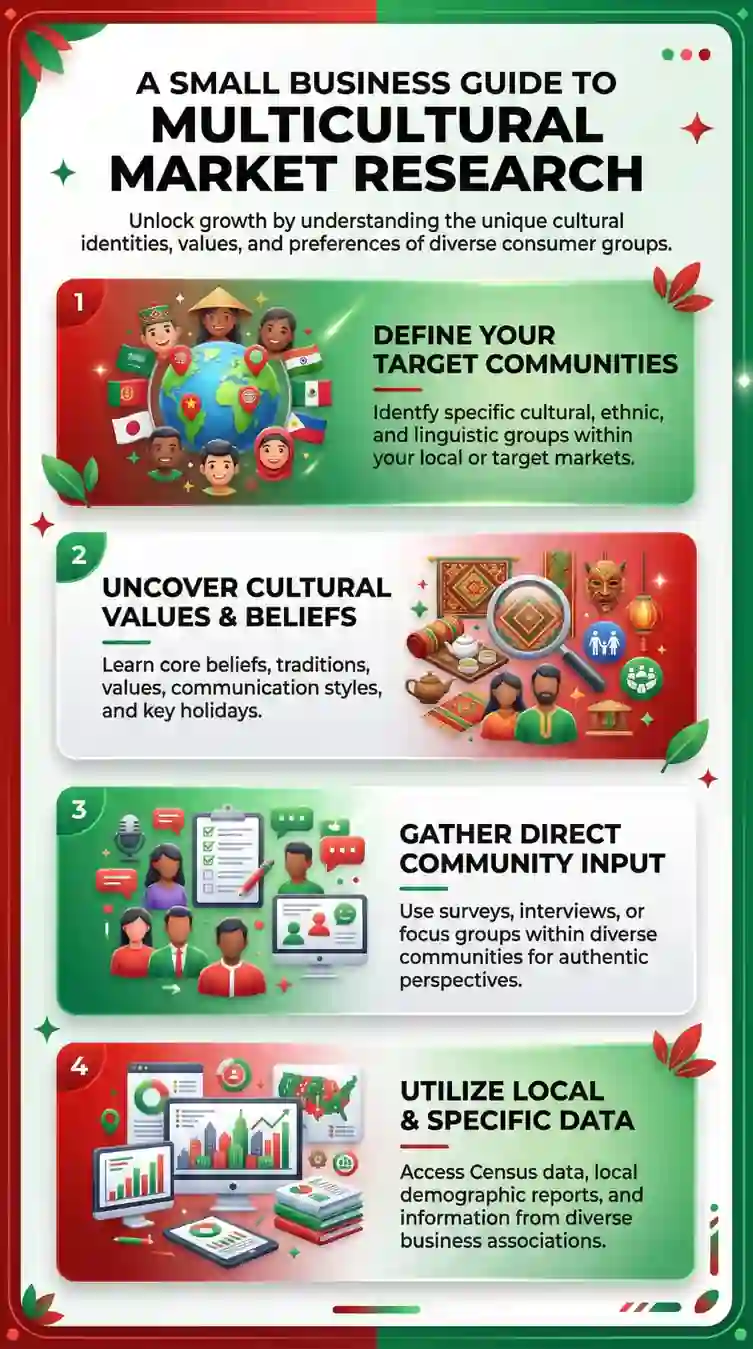
Before conducting any research, small businesses need to get specific about who they're trying to reach. Broad targets produce broad insights. Narrow targets produce actionable ones. Start by answering these foundational questions:
Which specific cultural communities does your current customer base reflect?
Which multicultural audiences represent your strongest untapped growth opportunity?
What cultural values, traditions, and communication preferences define those communities?
What languages do your target audiences speak at home versus in public life?
The answers to these questions become the foundation of every research initiative that follows — and every campaign strategy built on top of that research.
Low-Cost Multicultural Market Research Methods for Small Businesses
One of the most important things The Sax Agency tells small business clients is that meaningful multicultural market research doesn't require a six-figure research budget. Some of the most valuable cultural insights we've ever gathered came from methods that cost very little but required genuine curiosity and community presence. Effective low-cost research approaches include:
Customer interviews and conversations: Direct, open-ended conversations with existing multicultural customers reveal motivations, preferences, and unmet needs that survey data rarely captures.
Community observation: Attending local cultural events, following community social media accounts, and engaging with multicultural media outlets provides real-time cultural intelligence.
Social listening: Monitoring conversations on platforms like Instagram, TikTok, Facebook, and community forums within your target cultural groups surfaces organic insights about what matters most to those audiences.
Surveys with culturally relevant questions: Simple, well-designed surveys distributed through community channels can generate significant insight when questions are framed with cultural context in mind.
Secondary research: U.S. Census Bureau data, SBA reports, and industry research organizations provide robust demographic and behavioral data at no cost.
How to Analyze and Apply Multicultural Market Research
Gathering data is only half the work. The other half is knowing what to do with it. At The Sax Agency, we apply a straightforward three-step framework when analyzing multicultural market research for our clients:
Identify cultural patterns: Look for recurring values, preferences, and behaviors that appear consistently across your research data. These patterns form the cultural insights that should inform your messaging strategy.
Map insights to touchpoints: Connect cultural insights to specific marketing touchpoints — from the language and imagery in your advertising to the channels you use to distribute it and the community partnerships you build around it.
Test, measure, and refine: Launch campaigns based on your research insights, measure performance within your target multicultural segments, and use what you learn to continuously sharpen your cultural understanding.
Using Multicultural Market Research to Build Authentic Brand Connections
The ultimate goal of multicultural market research isn't data collection — it's connection. The most successful small businesses we've worked with use research not just to inform their advertising but to reshape how their entire brand shows up for diverse communities. That means ensuring multicultural representation in visual content, developing messaging that reflects community values rather than generic inclusion gestures, and building relationships with cultural community organizations, influencers, and media that serve your target audiences year-round — not just during cultural holidays or awareness months.
When to Partner With a Multicultural Marketing Agency for Research Support
There comes a point in every small business's multicultural growth journey where the complexity of audience research outpaces internal capacity. That's the moment to consider a specialized partner. A multicultural marketing agency like The Sax Agency brings established community relationships, proprietary cultural insights, and years of research experience that would take a small business years to develop independently. More importantly, we bring the kind of lived cultural perspective that no research methodology can fully replicate — the ability to look at data about a community and understand not just what it says, but what it means for creating inbound marketing that feels culturally fluent, earns trust, and attracts the right customers organically.
"The small businesses that consistently win in multicultural markets aren't the ones with the biggest research budgets — they're the ones with the deepest cultural curiosity. In all our years of building multicultural strategies from the ground up, the single most valuable insight we can offer any small business is this: stop researching your audience from the outside and start understanding them from the inside. The data will tell you what multicultural consumers do. Cultural proximity tells you why. And that is where every campaign worth building begins."
Essential Resources
At The Sax Agency, we believe the best multicultural strategies are built on the best available intelligence. These seven resources represent the research foundation we recommend to every small business serious about understanding and reaching diverse audiences — most of them free, all of them essential.
1. U.S. Small Business Administration — The Starting Point Every Small Business Needs for Market Research
Before investing a dollar in multicultural marketing, every small business owner should understand how to research their audience effectively. The SBA's free market research guide covers both primary and secondary research methods — including how to access demographic and consumer data tools that are directly applicable to diverse audience targeting. We point small business clients here first because it removes the most common barrier we see: not knowing where to begin. ???? https://www.sba.gov/business-guide/plan-your-business/market-research-competitive-analysis
2. U.S. Census Bureau — Free Demographic Data That Reveals the True Size of Your Multicultural Market Opportunity
One of the most powerful and consistently underused research tools available to small businesses is sitting at the U.S. Census Bureau — completely free. The Census Business Builder provides direct access to population, demographic, and economic data broken down by geography, ethnicity, and consumer behavior. In our experience, small businesses that take the time to explore this data almost always discover multicultural market opportunities in their own backyard that they didn't know existed. ???? https://www.census.gov/data/data-tools/cbb/help/sm-bus.html
3. Multicultural.com — The Industry's Deepest Well of Multicultural Consumer Research and Intelligence
Founded in 1994, Multicultural.com has been the industry's most established hub for multicultural market research longer than most digital marketing tools have existed. It connects small businesses with expert directories, consumer trend reports, and research resources covering Hispanic, Black, Asian, LGBTQ, and other diverse communities at a depth that general marketing platforms simply can't match. When our clients need to go beyond surface-level demographics, this is where we send them. ???? https://multicultural.com/markets/multicultural-market-research/
4. Pew Research Center — The Most Credible Free Source for Understanding How Diverse Communities Think, Feel, and Decide
Cultural intelligence isn't just about demographics — it's about values, attitudes, and worldviews. Pew Research Center's nonpartisan studies on race and ethnicity give small businesses free access to data-driven insights on how diverse American communities think, communicate, and make purchasing decisions. We reference Pew constantly in our own research work because the quality of their data is simply unmatched at no cost. ???? https://www.pewresearch.org/topics/race-and-ethnicity/
5. SBA Office of Advocacy — Government-Backed Data for Validating Multicultural Market Opportunities
The SBA Office of Advocacy gives small businesses free access to minority-owned business statistics, demographic research, and economic data reports that are invaluable for validating multicultural market opportunities before committing to a campaign strategy. For small businesses that need to build an internal business case for multicultural investment, this is the data that makes the argument impossible to ignore. ???? https://advocacy.sba.gov/small-business-data-resources/
6. Greenbook — Your Guide to Finding a Specialized Multicultural Market Research Partner
There comes a point in every growing small business's multicultural journey where the complexity of audience research requires a specialized partner. Greenbook's curated directory connects small businesses with leading market research firms that specialize in multicultural audience insights — including qualitative and quantitative providers with proven expertise across Black, Hispanic, Asian, and other diverse consumer communities. When internal capacity isn't enough, this is where to find the right research partner. ???? https://www.greenbook.org/market-research-firms/ethnic-multi-cultural
7. Library of Congress — A Comprehensive, Free Research Guide Designed Specifically for Small Business Owners
The Library of Congress Small Business Market Research Guide is one of the most overlooked free resources in the small business community — and one of the most valuable. It connects entrepreneurs with demographic data, consumer expenditure surveys, and industry reports curated specifically for small businesses building audience profiles without enterprise-level research budgets. We recommend it to every small business client who tells us they don't have the resources to do proper multicultural research — because this resource proves that assumption wrong. ???? https://guides.loc.gov/small-business-hub/planning/market-research
These essential resources give a multicultural SEO agency a powerful, mostly free research foundation to uncover high-intent multicultural search demand, understand cultural nuances, and build content strategies that rank, resonate, and drive measurable growth for small businesses.
Supporting Statistics
At The Sax Agency, we've never had to convince a small business that multicultural audiences matter. What we do have to do — consistently — is show them how much they're underestimating the opportunity in front of them. These four statistics do that better than any pitch we could make.
Stat #1 — Minority-Owned Businesses Now Represent 22.6% of All U.S. Employer Firms Source: U.S. Census Bureau — 2023 Annual Business Survey ???? https://www.census.gov/newsroom/press-releases/2024/employer-businesses.html
Key findings:
1.3 million U.S. employer firms — 22.6% of the total — are minority-owned
Hispanic-owned businesses grew 8.2% in a single year
Black-owned firms' gross revenue grew 66% between 2017 and 2022
Minority-owned businesses generate hundreds of billions in annual revenue
The Sax Agency perspective:
We've sat across from small business owners who described multicultural audiences as secondary
Then we showed them numbers like these
The conversation changes immediately
Minority-owned businesses aren't a niche — they're a primary driver of U.S. economic growth
Small businesses that build authentic relationships within these communities now are building advantages that compound for years
Stat #2 — Hispanic-Owned Businesses Are Among the Fastest-Growing in the U.S. Economy Source: U.S. Census Bureau — Hispanic-Owned Businesses Data ???? https://www.census.gov/library/stories/2024/10/hispanic-owned-businesses.html
Key findings:
Hispanic-owned firms represent 7.1% of all U.S. employer businesses
Hispanic business ownership grew 46.3% in just five years — from 2.3 million to 3.3 million firms
20% of Hispanic business owners are under 35 — vs. just 14% for all business owners nationally
Top sectors: Construction, Accommodation and Food Services, Professional Services
The Sax Agency perspective:
The youth skew of Hispanic business ownership is the stat that surprises clients most
Younger Hispanic entrepreneurs are more digitally connected and more brand-aware
In our direct experience working within Hispanic communities across Los Angeles, brands that show up authentically early don't just earn customers
They earn advocates
Stat #3 — Black Adults See Business Ownership as Central to Financial Success — And the Numbers Back It Up Source: Pew Research Center — A Look at Black-Owned Businesses in the U.S. ???? https://www.pewresearch.org/short-reads/2025/02/12/a-look-at-black-owned-businesses-in-the-us/
Key findings:
More than 1 in 5 Black adults say owning a business is essential to their personal definition of financial success
Majority Black-owned U.S. firms grew 57% — from 124,004 in 2017 to 194,585 in 2022
Black-owned firms' gross revenue grew 66% over that same five-year period
Black-owned businesses still represent only 3% of all U.S. employer firms
The Sax Agency perspective:
That 3% figure is the one that stops people cold — and it should
It represents not just underrepresentation but extraordinary unrealized market potential
What we've seen firsthand: brands earning long-term loyalty in Black communities aren't the ones with the biggest budgets
They're the ones that showed up consistently, respectfully, and authentically — every month, not just during Black History Month
That kind of presence starts with research
Stat #4 — Small Businesses Make Up 99.9% of All U.S. Businesses — But Most Still Lack a Multicultural Research Strategy Source: U.S. Small Business Administration Office of Advocacy — 2024 Small Business Profile ???? https://advocacy.sba.gov/2024/11/19/2024-small-business-profiles-for-the-states-territories-and-nation/
Key findings:
34.8 million small businesses operate in the United States
Small businesses represent 99.9% of all U.S. businesses
Small businesses employ 45.9% of the entire U.S. workforce
1.3 million new establishments opened between March 2022 and March 2023 — a boom driven significantly by women and people of color
The Sax Agency perspective:
34.8 million small businesses — and most are still marketing to diverse audiences based on gut instinct rather than research
We know this because we talk to those business owners regularly
The ones who commit to even a basic multicultural research process consistently outperform the ones who don't
Not eventually — quickly
The research doesn't require a big budget or a dedicated team
It requires intention
And that's exactly what this guide provides
Final Thought & Opinion
After years of helping small businesses connect authentically with diverse audiences, here is the observation The Sax Agency comes back to again and again:
The research gap in small business multicultural marketing isn't a resource problem. It's a priority problem.
Why Most Small Businesses Fall Short
Small business owners are resourceful by nature. The ones struggling with multicultural market research aren't struggling because they lack tools — most of the best research resources are completely free. They're struggling because nobody told them that understanding diverse audiences deserves the same rigor as:
Financial planning
Operations management
Product development
Brand strategy
What We've Seen Firsthand
We've watched the same pattern repeat across industries and markets:
A small business invests in beautiful branding, a polished website, and solid social media
Then wonders why it isn't resonating with the diverse community right outside its front door
The answer, almost every time, is the same
They built everything around assumptions instead of insight
They marketed to who they thought their multicultural customers were instead of who those customers actually are
That distinction — between assumption and insight — is the entire reason multicultural market research exists.
What the Small Businesses Winning in Multicultural Markets Have in Common
After years of working directly inside diverse communities, we've identified three consistent traits:
They started research before they needed it — not after a campaign missed the mark
They treated cultural understanding as an ongoing practice — not a one-time project
They approached diverse audiences with genuine curiosity — asking not just who their customers are but what they value, what they trust, and what makes them feel seen
None of that requires a research department. It requires intention, consistency, and a willingness to listen before you speak.
The Opportunity the Data Makes Impossible to Ignore
Multicultural consumers represent trillions in U.S. buying power
Minority-owned businesses are among the fastest-growing segments of the U.S. economy
Diverse audiences reward authenticity with brand loyalty that sustains businesses through every market cycle
The overwhelming majority of small businesses still have no formal multicultural research strategy
That gap is both a problem and an opportunity. For small businesses willing to close it, the competitive advantage on the other side is significant.
The Bottom Line
At The Sax Agency, we built our entire practice on one foundational belief:
Cultural understanding isn't a marketing tactic. It's a business foundation.
For small businesses ready to build that foundation the right way — the research starts here.
FAQ on Small Business Multicultural Market Research
Q: What is multicultural market research and why does it matter for small businesses?
A: Multicultural market research is the process of understanding the values, preferences, behaviors, and purchasing habits of diverse cultural audiences — as real communities with distinct identities, not demographic checkboxes. Why it matters for small businesses:
Multicultural consumers represent over $5 trillion in U.S. buying power
Minority-owned businesses make up 22.6% of all U.S. employer firms
Diverse audiences reward authentic brands with loyalty that outlasts any ad campaign
Small businesses that research multicultural audiences consistently outperform those that rely on assumptions
The Sax Agency has learned from years of direct experience: the small businesses growing fastest in diverse markets aren't the ones spending the most. They're the ones listening the most.
Q: How can a small business conduct multicultural market research on a limited budget?
A: Budget is rarely the real barrier. The most effective low-cost approaches we recommend:
Customer conversations — Direct, open-ended conversations reveal why diverse customers buy. Survey data tells you what people do. Conversations tell you why — and the why is where every effective campaign begins
Community observation — Attend local cultural events. Follow community social media. Engage with multicultural media. This provides real-time cultural intelligence no research report can fully replicate
Social listening — Organic conversations on Instagram, TikTok, and community forums are among the most honest research data available — and they're free
Free government data — U.S. Census Bureau, SBA, and Pew Research Center offer more robust demographic research than most small businesses ever use
Culturally framed surveys — Simple surveys built around cultural context — not just demographics — distributed through community channels can reshape an entire marketing strategy
The research doesn't have to be expensive. It has to be intentional.
Q: What are the most common mistakes small businesses make in multicultural market research?
A: After years of working with small businesses at every stage of multicultural marketing maturity, The Sax Agency sees the same mistakes surface repeatedly:
Treating multicultural audiences as a single group — Black, Hispanic, Asian, and other communities are each distinct. Broad assumptions produce superficial reach and no real resonance
Researching once and moving on — Cultural understanding isn't a project with a finish line. It's an ongoing practice
Ignoring language and dialect nuance — Brands that communicate in culturally relevant ways see dramatically deeper engagement than those that simply translate existing messaging
Building strategy without community proximity — Research conducted from outside a community produces insights that feel accurate on paper and ring hollow in practice
Measuring the wrong outcomes — Standard engagement metrics miss the community trust that drives the most durable multicultural growth
Q: What free resources are available for small business multicultural market research?
A: The research tools small businesses need already exist — and most are free. The five we recommend most:
U.S. Census Bureau Census Business Builder — Free demographic and economic data by geography, ethnicity, and consumer behavior. Small businesses that spend even an hour here almost always find multicultural opportunities in their own backyard ???? https://www.census.gov/data/data-tools/cbb/help/sm-bus.html
SBA Market Research & Competitive Analysis Guide — The starting framework every small business needs before conducting audience research. Free and built specifically for business owners without dedicated research teams ???? https://www.sba.gov/business-guide/plan-your-business/market-research-competitive-analysis
Pew Research Center — Race & Ethnicity — The most credible free source for understanding how diverse American communities think, communicate, and make decisions. We reference Pew constantly in our own strategy work ???? https://www.pewresearch.org/topics/race-and-ethnicity/
SBA Office of Advocacy — Small Business Data Resources — Government-backed minority business statistics for validating multicultural market opportunities before committing to strategy ???? https://advocacy.sba.gov/small-business-data-resources/
Library of Congress Small Business Research Guide — One of the most overlooked free resources available. Connects entrepreneurs with demographic data and consumer surveys curated for audience profiling on limited budgets ???? https://guides.loc.gov/small-business-hub/planning/market-research
Q: When should a small business consider partnering with a multicultural marketing agency for research support?
A: Earlier than most small businesses think. Five signals that tell us a small business is ready for a specialized multicultural agency partner:
Campaigns are reaching diverse audiences but not resonating — Reach without resonance is almost always a cultural intelligence gap. More budget won't close it without first addressing the cultural understanding underneath
Your team doesn't reflect the audiences you're targeting — A specialized agency bridges the lived experience gap in ways training and secondary research simply can't replicate
You've experienced a cultural misstep in a past campaign — One misaligned campaign can set back community trust for years. Getting it right the first time is always easier than the recovery
You're entering a new multicultural market segment — New audience development requires cultural intelligence most small businesses haven't had the time or proximity to build
Multicultural growth has plateaued despite consistent investment — When the budget is there but results aren't moving, the strategy needs cultural recalibration. That's the work The Sax Agency was built to do — and it always starts with going back to the research
In A Small Business Guide To Multicultural Market Research, the big takeaway is that the best insights come from looking past assumptions and learning how real people live, decide, and prioritize based on context and constraints, which is why we encourage small teams to adopt a “multiple-sources, cross-check, validate” approach. Even outside marketing, the same research mindset shows up in practical decisions, like understanding Why Your Central Air Has Two Filters to see how a system’s setup changes performance and outcomes, or comparing providers through a broader lens like HVAC Installation Companies when you need a clear view of options and differentiators. And when your research reaches the decision stage, you still need proof points you can verify quickly, like checking product specs and fit across marketplaces such as HVAC air filter replacement (Amazon), 20x22x1 MERV 11 air filters (Walmart), or 17x26x4 MERV 13 air filters (eBay). The through-line is the same: strong multicultural market research helps small businesses make smarter, more confident choices by grounding every message and move in what’s true for the audience, not what’s convenient for the brand.