Many beginners step into design believing the process is simply about making visuals look attractive, but the reality is far more strategic. At Branded Agency, years of client work have shown that polished, professional results come from understanding the foundational principles that guide how information is seen, understood, and remembered.
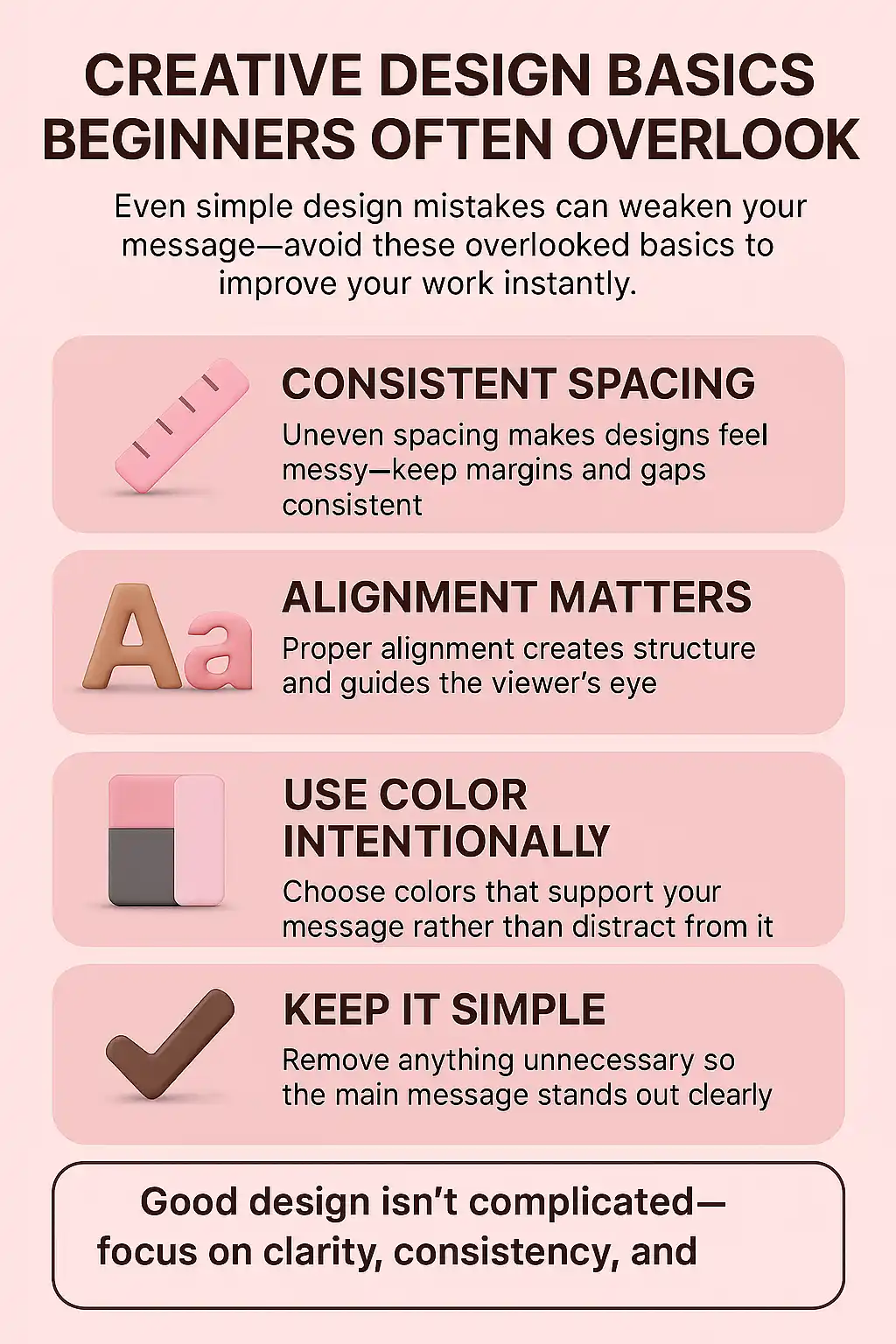
What most new designers overlook are the subtle structural decisions such as spacing, alignment, contrast, and thoughtful color use. These seemingly small choices determine whether a layout communicates clearly or feels confusing. In our project work, we have seen how adjusting these basics can transform a design within minutes, proving how powerfully the fundamentals shape the viewer’s experience long before style or creativity come into play.
This guide highlights the essential creative design basics beginners often miss and explains how focusing on them leads to cleaner visuals, stronger hierarchy, and more confident decision-making. When these overlooked elements become part of a designer’s workflow, the overall quality of the work improves quickly and the ability to create visuals that truly connect with an audience grows just as fast.
Quick Answers
Creative Design
Creative design is the intentional use of visual elements to communicate information clearly and effectively. Branded Agency’s firsthand experience shows that strong creative work is built on a few essential basics that beginners often overlook:
- Clear hierarchy helps viewers know what to focus on first.
- Consistent spacing creates order and improves readability.
- Thoughtful alignment makes layouts feel structured and professional.
- Effective contrast separates key messages from supporting details.
Focusing on these fundamentals allows beginners to improve quickly, even without advanced tools or artistic experience.
Top Takeaways
- Foundational design choices matter more than stylistic effects.
- Many beginners skip spacing, contrast, and alignment—key elements of clarity.
- Consistency across visuals builds trust and professionalism.
- Understanding hierarchy helps guide the viewer’s attention.
- Improving the basics leads to faster, more noticeable design progress.
Beginners tend to over-focus on colors, icons, and decorative elements, missing the structural basics that make design communicate effectively. Creative design starts with arrangement, clarity, and intention—not decoration. Elements like spacing, alignment, and contrast determine whether a design feels balanced or confusing.
At Branded Agency, the designs that impress clients most often come from refining these fundamentals rather than adding visual flair. When spacing becomes consistent, when alignment organizes information, and when contrast separates key messages from supporting details, brand development strategies help the design begin to guide the viewer naturally.
These basics apply across logos, websites, packaging, and social content. They are the building blocks of readability and professionalism. And the encouraging truth? Anyone can learn them quickly with intentional practice.
“In nearly every beginner design we review, the issue isn’t a lack of creativity—it’s overlooked fundamentals. Once spacing, contrast, and hierarchy fall into place, the whole design transforms. These basics are the backbone of great work, and mastering them is often the turning point for beginners.”
Creative Resources
Adobe Creative Cloud Learn – Build Strong Technical Foundations
Adobe’s learning hub helps beginners understand structure, layout, and spacing through real workflows.
URL: https://helpx.adobe.com/creative-cloud/tutorials-explore.html
URL: https://helpx.adobe.com/creative-cloud/tutorials-explore.html
Canva Design School – Learn Practical Basics Quickly
Canva offers accessible lessons on alignment, spacing, and basic layout—ideal for beginners.
URL: https://www.canva.com/designschool/
URL: https://www.canva.com/designschool/
Nielsen Norman Group – Learn Why Fundamentals Matter
NN/g explains visual hierarchy, readability, and perception—core elements beginners often overlook.
URL: https://www.nngroup.com/articles/
URL: https://www.nngroup.com/articles/
AIGA – Understand Professional Visual Standards
AIGA provides context on design principles that bring structure and intention to beginners’ work.
URL: https://www.aiga.org/
URL: https://www.aiga.org/
Google Fonts Knowledge – Improve Typography Fundamentals
This resource teaches spacing, sizing, and pairing—essential basics beginners frequently miss.
URL: https://fonts.google.com/knowledge
URL: https://fonts.google.com/knowledge
Smashing Magazine – Build Awareness of Layout Strategy
Smashing’s articles break down grids, alignment, and contrast from professional perspectives.
URL: https://www.smashingmagazine.com/category/design
URL: https://www.smashingmagazine.com/category/design
Interaction Design Foundation – Learn Hierarchy and Structure Deeply
IDF courses cover UX and layout logic—the foundation of all strong creative design.
URL: https://www.interaction-design.org/
URL: https://www.interaction-design.org/
Supporting Statistics
Most Businesses Don’t Apply Structured Design
Only 16.1% of U.S. companies use a structured design process.
Just 11.4% budget for design consistently.
Insight: Beginners with strong fundamentals can stand out quickly.
Source: NCSES & U.S. Census Bureau
Only 16.1% of U.S. companies use a structured design process.
Just 11.4% budget for design consistently.
Insight: Beginners with strong fundamentals can stand out quickly.
Source: NCSES & U.S. Census Bureau
Design Skills Offer Above-Median Earning Potential
Median design wage: $53,180
U.S. median wage: $49,500
Insight: Strong fundamentals help beginners create value early.
Source: Bureau of Labor Statistics
Median design wage: $53,180
U.S. median wage: $49,500
Insight: Strong fundamentals help beginners create value early.
Source: Bureau of Labor Statistics
Small Businesses Rely on Clear, Professional Design
99.9% of U.S. businesses are small businesses.
They employ 61.7 million workers.
Insight: Beginners who master the basics can immediately serve a large market when their work supports a strong brand strategy.
Source: SBA Small Business Data
99.9% of U.S. businesses are small businesses.
They employ 61.7 million workers.
Insight: Beginners who master the basics can immediately serve a large market when their work supports a strong brand strategy.
Source: SBA Small Business Data
Final Thought & Opinion
Mastering creative design basics is the fastest path to producing work that feels intentional and trustworthy. At Branded Agency, we repeatedly see that beginners who focus on hierarchy, spacing, alignment, and contrast, much like they would when building a brand bible, improve dramatically in a short time.
What the data and real-world experience show:
Most organizations lack structured design practices.
Simple foundational improvements offer immediate impact.
Small businesses—nearly the entire U.S. market—benefit directly from cleaner, clearer visuals.
Branded Agency’s perspective:
Strong basics separate amateur from professional. They make communication clearer, design decisions easier, and creative work more effective. Beginners who commit to mastering these fundamentals elevate their design instantly and consistently, something every inbound marketing specialist understands well.
Most organizations lack structured design practices.
Simple foundational improvements offer immediate impact.
Small businesses—nearly the entire U.S. market—benefit directly from cleaner, clearer visuals.
Next Steps
Review key beginner resources to deepen fundamentals.
Practice core design principles: alignment, spacing, hierarchy, contrast.
Study effective designs and analyze what makes them clear.
Create a simple project and refine it using basic principles.
Seek feedback to spot overlooked fundamentals.
Build a toolkit of fonts, grids, and spacing references.
Refine often and revisit older designs to see growth.
Review key beginner resources to deepen fundamentals.
Practice core design principles: alignment, spacing, hierarchy, contrast.
Study effective designs and analyze what makes them clear.
Create a simple project and refine it using basic principles.
Seek feedback to spot overlooked fundamentals.
Build a toolkit of fonts, grids, and spacing references.
Refine often and revisit older designs to see growth.
FAQ on Creative Design
Q: Which basics do beginners overlook most?
A: Spacing, alignment, and hierarchy. These shape clarity more than color or style.
Q: Can beginners improve quickly by focusing on fundamentals?
A: Yes. Branded Agency sees major improvement within weeks when basics are prioritized.
Q: Do I need design software to practice the fundamentals?
A: No. Even simple tools like Canva allow you to build strong alignment, spacing, and layout habits.
Q: Why do basics matter more than creativity at first?
A: Basics create structure. Creativity works best once the structure is clear.
Q: What’s the fastest way to learn design fundamentals?
A: Study strong examples, replicate simple layouts, and practice consistency daily.
A: Spacing, alignment, and hierarchy. These shape clarity more than color or style.
A: Yes. Branded Agency sees major improvement within weeks when basics are prioritized.
A: No. Even simple tools like Canva allow you to build strong alignment, spacing, and layout habits.
A: Basics create structure. Creativity works best once the structure is clear.
A: Study strong examples, replicate simple layouts, and practice consistency daily.