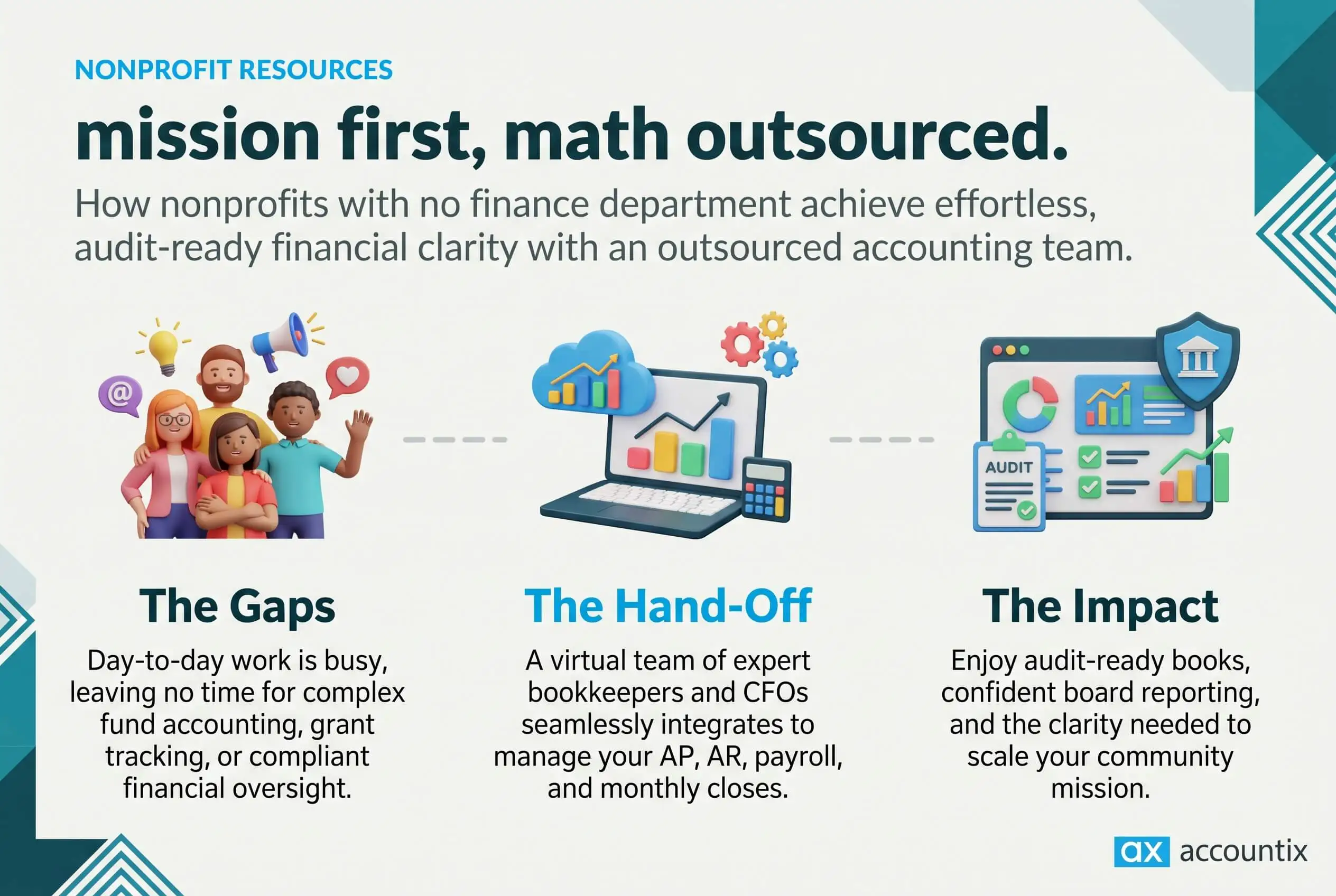
Who tracks your restricted grant dollars when nobody on staff has "finance" in their title? With outsourced accounting, an outside team does. That team also keeps your books, closes them every month, and prepares the reports your board reviews, while your executive director and board keep every approval.
For a small, mission-driven organization, outsourced accounting for nonprofits delivers the oversight of a finance department without the cost of hiring one. Your stakeholders get audit-ready books and clear reporting. Your staff gets time back for programs.
If you already work with an outside agency on marketing, the logic will feel familiar. You don't need to build a finance department to run your finances well.
TL;DR Quick Answers
Outsourced Accounting for Nonprofits
Outsourced accounting for nonprofits means an outside accounting team runs your finance function while your executive director and board keep every approval. You don't need to build a finance department to have audit-ready books.
Who it's for: Nonprofits with no finance staff, or a part-time bookkeeper the work has outgrown.
What it covers: Bookkeeping, month-end close, restricted fund and grant tracking, functional expense splits, budget-to-actuals, and audit and Form 990 support.
Who stays in control: Your staff approves bills and releases payments. Your board approves the budget and selects the auditor.
How it runs: A cleanup and system setup first, then a monthly close and quarterly board reporting.
Levels of support: Nonprofit bookkeeping, outsourced accounting, and fractional CFO. Start with what you need today and add more as you grow.
Cost: A weekly fee scaled to your volume. Accountix nonprofit services start at $200 per week.
Top Takeaways
Your staff and board keep every approval while the partner handles the books.
Restricted funds stay current month to month, which makes audits faster and calmer.
Plan on weekly transaction work, a monthly close, and quarterly board reports.
Separating approval from recording gives small teams stronger controls.
What Outsourced Accounting Covers When You Have No Finance Staff
Your partner takes on the work a finance department would handle, along with the rules that apply only to nonprofits. In broad terms, accounting outsourcing means hiring an outside provider to run accounting and internal financial controls. That work falls into two groups.
Day-to-day transactions: paying bills, recording gifts, posting payroll, and reconciling bank and card accounts.
Review and reporting: monthly financial statements, budget-to-actual reports, compliance, and planning.
Nonprofit accounting adds another layer. Grants and gifts often restrict how money can be spent, so every dollar has to be tracked by fund, grant, or program. Expenses also get split across programs, administration, and fundraising, and those functional expense splits flow straight into your Form 990. A partner with nonprofit experience keeps all of this current every month, so it's ready long before your auditor asks.
How Outsourced Accounting Works, Step by Step
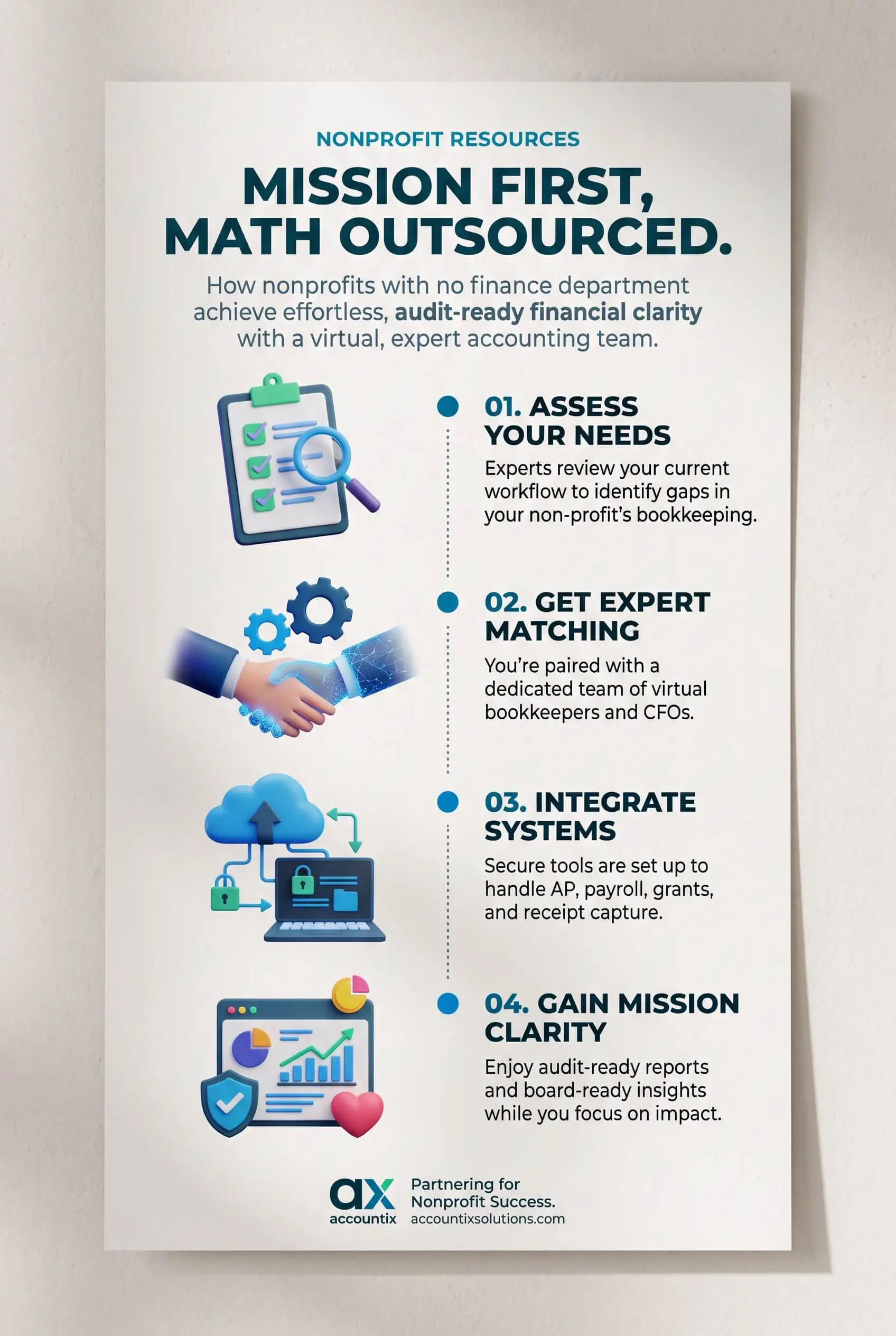
Most engagements begin with cleanup and setup, then settle into a monthly routine.
Assess and clean up. Your partner reviews current books, bank statements, and grant agreements, corrects miscoded transactions, and sets an accurate opening balance for each fund.
Connect your systems. Your partner links your accounting software, bank feeds, payroll, donor database, and bill-pay tools so data flows in without retyping. For many nonprofits, that means QuickBooks working alongside platforms like Bloomerang, DonorPerfect, BILL, or Ramp.
Run the monthly close. The team codes each transaction to the right fund and program, reconciles every account, and reviews the numbers before you see them.
Report to leadership and the board. You receive financial statements, budget-to-actuals, and restricted fund balances written in plain language your board can follow.
Handle year-end. Your accountant prepares the schedules your auditor requests and works with your tax preparer on the Form 990.
Expect weekly transaction work, a monthly close, and a quarterly board packet. The audit and 990 cycle comes around once a year.
Who Does What: Your Team vs. Your Accounting Partner
Your staff and board keep approval authority while your partner handles the recording and reporting.
Approving bills and reimbursements: You approve. Your partner prepares each one for review.
Signing checks and releasing payments: Your nonprofit only.
Coding and recording transactions: Your partner.
Reconciling bank and card accounts: Your partner.
Tracking grant and donor restrictions: You share the agreements, and your partner tracks balances monthly.
Preparing financial and board reports: Your partner prepares them, and you review and present them.
Setting the annual budget: You own and approve it. Your partner builds it into monthly reporting.
Hiring the independent auditor: Your board selects the firm. Your partner prepares the audit schedules.
Filing the Form 990: You sign. Your partner coordinates preparation.
Auditors call this segregation of duties. When the person approving a payment isn't the person recording it, mistakes and misuse have a much harder time slipping through. That separation is tough to build when one staff member does everything, and outsourcing gives it to you without adding headcount.
Outsourced Accounting for Nonprofits vs. Hiring In-House
For most small nonprofits, an outside team costs less than a full-time hire and brings more skills to the table. There are trade-offs, and they're manageable.
Cost: An in-house hire comes with salary, benefits, training, and software. An outsourced team charges a weekly or monthly fee scaled to your volume.
Turnover: When a solo bookkeeper leaves, the books stall until you rehire. With a team, the work keeps moving.
Skills: One hire brings one person's experience. An outsourced team brings bookkeepers, accountants, and CFO-level advisors.
Technology: In-house, you buy and maintain the tools. A partner shows up with tested tools and integrations.
Growth: Growing in-house means another hire, while an outsourced scope expands with your programs.
Leaders usually raise two worries: losing control of their data and leaning too hard on one provider. Both have practical fixes. Keep ownership of your accounting file, set user-level access, and make sure your records stay portable. Then agree on a regular meeting rhythm with a named contact so questions never sit for weeks. Many leaders weigh the same trade-offs when they bring in outside marketing help, which The Pros and Cons of Hiring a Marketing Agency lays out well.
How to Choose the Right Level of Support
Support works like a ladder, and most nonprofits start on the rung that matches today's problems.
Nonprofit bookkeeping: clean, timely records and fund balances you can trust.
Nonprofit outsourced accounting: a reviewed monthly close, grant reporting, budget-to-actuals, and audit coordination.
Nonprofit fractional CFO: forecasting, cash planning tied to grant timing, and board-level strategy.
Before you sign with any provider, ask these four questions:
How many nonprofits do you work with right now?
How do you keep restricted and unrestricted funds separate?
Which accounting, donor, and payment platforms do you support?
What will our board receive each month or quarter, and who will we talk to day to day?
"The pattern we see most is restricted grant money sitting in the same pool as general funds, with nobody sure how much of each grant is left. Once we track restrictions by fund every month, the audit stops being a reconstruction project. Boards start asking sharper questions too, because they finally trust the numbers in front of them. Moving from rebuilding last year to reviewing last month is where outsourcing pays for itself."
7 Essential Resources
These sources explain the rules your accounting partner works within, so you know what to expect from them.
Accounting Outsourcing (Wikipedia): a neutral overview of what gets outsourced, why organizations do it, and the common drawbacks.
About Form 990 (IRS): the official home for the annual information return, its instructions, and its schedules.
Charities and Nonprofits (IRS): the IRS hub for tax-exempt rules, filing requirements, and compliance guidance.
Nonprofit Audit Guide (National Council of Nonprofits): a 50-state look at when audits are required, plus the board's role in the process.
Simplifying Adoption of the NFP Financial Reporting Standard (Journal of Accountancy): a CPA-written background piece on how nonprofit financial statements present restricted funds and functional expenses.
State of the Nonprofit Sector Survey (Nonprofit Finance Fund): survey findings from 2,206 nonprofits on finances, cash, and demand.
How Nonprofits Can Benefit from Outsourced Accounting (NJCPA): a CPA society's 2026 take on what to outsource, which metrics to track, and how to prepare for audits.
These seven resources explain nonprofit accounting requirements, including IRS compliance, Form 990 reporting, audit preparation, restricted funds, and financial oversight, helping organizations searching for outsourced accounting and bookkeeping services near me understand what to expect from a qualified accounting partner.
3 Statistics
1. More than a third of nonprofits ran deficits in 2024. The Nonprofit Finance Fund's 2025 survey found that 36% of responding nonprofits ended 2024 with an operating deficit, the highest share in a decade of NFF survey data. Thin margins leave little room for surprises, which is why monthly numbers matter more than a once-a-year look.
2. Over half have three months of cash or less. In the same Nonprofit Finance Fund survey, 52% of respondents had three months or less of cash on hand, and 18% had a month or less. When one late grant payment can squeeze payroll, cash planning has to follow the dates money actually arrives.
3. Working with a finance partner is now the norm. The NonProfit Times reported in June 2026 that 81% of nonprofit finance leaders polled work with a finance and accounting partner. That figure comes from a BTQ Financial survey of 100 nonprofits with $3 million to $150 million in annual revenue. Smaller organizations weren't in the sample, but the direction is hard to miss for anyone weighing the move.
Final Thoughts and Opinion
Plenty of well-run nonprofits have no finance department, and for most small organizations that's the right call. Boards weigh every overhead dollar against programs.
The question is whether the work gets done well. We believe outsourced accounting for nonprofits, done right, gives a five-person team the same controls a much larger organization has: books closed every month, restricted funds tracked as they move, and a board that sees accurate numbers on a schedule.
Outsourcing won't fit everyone. An organization with a handful of transactions a month may only need a part-time bookkeeper, and no outside partner replaces the judgment of your executive director and board. But if finance tasks keep eating into program time, or your inbound marketing budget needs closer financial oversight, or your last audit felt like an archaeology dig, it's worth a conversation.
Frequently Asked Questions
How much does outsourced accounting for nonprofits cost?
Pricing depends on how many transactions you process, how many grants you track, and how much reporting your board needs. You'll usually pay a weekly or monthly fee instead of a salary. Accountix services for nonprofits start at $200 per week, and Accountix tailors the final scope to your needs, complexity, and challenges.
What does an outsourced accountant do for a nonprofit?
They record transactions, reconcile accounts, track restricted funds by grant or program, and prepare monthly statements and budget-to-actual reports. At year-end, they pull together the schedules your auditor asks for and help coordinate the Form 990. With CFO-level support, they'll also forecast cash and present to your board.
Can a very small nonprofit outsource its accounting?
Yes, and smaller organizations often benefit most because a full-time finance hire is out of reach. The work happens remotely and scales to your volume. If your transaction volume is light, bookkeeping alone may cover you for now, and you can add accounting or CFO support as your programs grow.
Who prepares the Form 990 when accounting is outsourced?
Your accounting partner maintains the books and functional expense splits the 990 is built from, then works with the CPA firm or tax preparer who files it. Your organization reviews and signs the return. Ask any provider up front whether 990 coordination sits inside their scope.
Does the board still need a treasurer if accounting is outsourced?
Yes. A treasurer provides oversight, and outsourcing makes that job easier with timely statements, clear restricted fund balances, and someone on call to answer questions. The board still approves the budget, reviews financial reports, and picks the independent auditor.
Will we lose control of our finances if we outsource?
Not when the arrangement is set up well. Your staff approves bills and releases payments, you own your accounting file, and you decide who has access. A standing meeting with a named contact keeps questions moving, and no payment goes out without your sign-off.
Ready to Take Finance Off Your Plate?
Accountix works with mission-driven organizations across the country from its home base in Santa Barbara. Book a 30-minute intro call, and we'll look at where your books stand and which level of support from an outsourced accounting firm fits. You don't need to build a finance department, and there's no hard sell.


